Sleep is an active process
Sleep pressure generally builds over waking hours. Circadian rhythms, aligned partly by light, influence when the body is ready to sleep or wake. These two processes interact. During relaxed, eyes-closed wakefulness, posterior alpha may be prominent. As a person drifts off, that activity often gives way to a less regular, lower-frequency pattern. Waking, drowsiness and sleep form a changing sequence rather than a switch at one frequency. [1] [2]
A night moving through stages
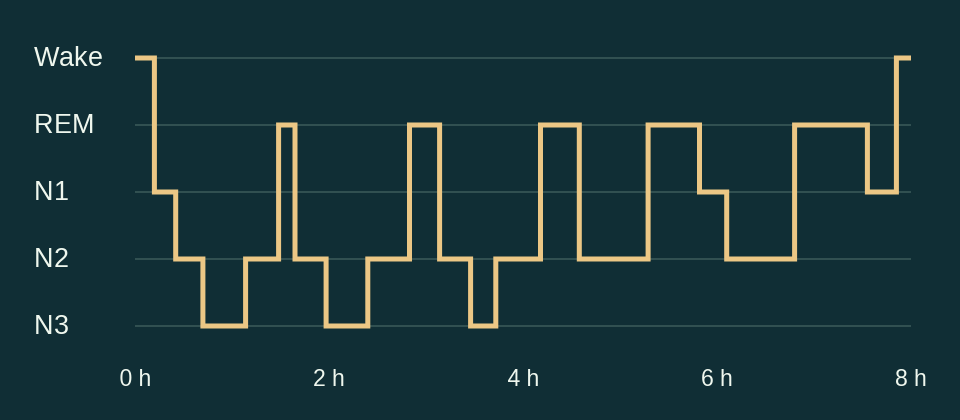
| Stage | Typical signs |
|---|---|
| N1 | The transition into sleep. Mixed activity and slow eye movements may appear. |
| N2 | Spindles and K-complexes punctuate the EEG. |
| N3 | Slow-wave non-REM sleep, with prominent slow activity. Often more abundant early in the night. |
| REM | Rapid eye movements, relatively low skeletal muscle tone and mixed-frequency EEG. REM periods often lengthen later. |
A full sleep study uses EEG, eye movements and muscle tone together. Cycles often recur roughly every 80–100 minutes, with substantial variation. Dreaming is often vivid in REM, and reports of dreams also occur after awakening from non-REM sleep. Remembering a dream and having one are separate questions. [3] [1]
Updating three older explanations
Theta activity alone does not identify REM. It can occur during drowsiness, lighter non-REM sleep and other states. Sleepwalking most often arises from deep non-REM sleep. Acting out dreams in REM when typical muscle atonia is lost is a separate condition. Narcolepsy is a neurological disorder of sleep–wake regulation. Loss of hypocretin-producing cells is implicated in type 1, while mechanisms for type 2 are less clear. Cervical misalignment is not an established cause. [4] [5]
When the experiment measures the sleeper
In a closed-loop laboratory study, an EEG system measured a sleeper’s slow oscillations and timed auditory pulses to the ongoing rhythm. In one study the intervention changed EEG and memory measures. A later experiment reported changes in sleep oscillations without a memory improvement. An ordinary recording has no way to read a sleeper’s EEG or time stimuli to its phase. Studies of this kind offer clues about how the sleeping brain processes input. They do not settle the wider question of how conscious experience changes at night. [6] [7]
Let the evening sound stay in the background
Quiet or a soft familiar soundscape can help mark the end of a day as a personal routine. Consider low-volume ambient music, a natural sound or a short Delta Series recording. A timer or fade makes it easier to end the sound. Stop if it interferes with rest. Persistent sleep or daytime alertness problems deserve appropriate professional care. [8]
Sources and further reading
- NINDS. Brain Basics: Understanding Sleep.
- Nick Kane and colleagues. Revised clinical electroencephalography glossary, IFCN (2017).
- NHLBI. How Sleep Works: Sleep Phases and Stages.
- MedlinePlus. Sleepwalking.
- NINDS. Narcolepsy.
- Hong-Viet V. Ngo, Thomas Martinetz, Jan Born and Matthias Mölle. Auditory closed-loop stimulation of the sleep slow oscillation enhances memory. Neuron (2013).
- Simon Henin and colleagues. Closed-loop acoustic stimulation enhances sleep oscillations but not memory performance. eNeuro (2019).
- World Health Organization. Deafness and hearing loss: Safe listening.