
One pitch, another rate
A carrier is the audible tone on which a rhythmic pattern is built. Pitch is the listener’s sense of highness or lowness. A beat or offset is a difference between frequencies, and a pulse rate describes how often a sound gets louder or repeats. Hertz counts cycles per second in both cases. Identical units do not imply identical sensations.
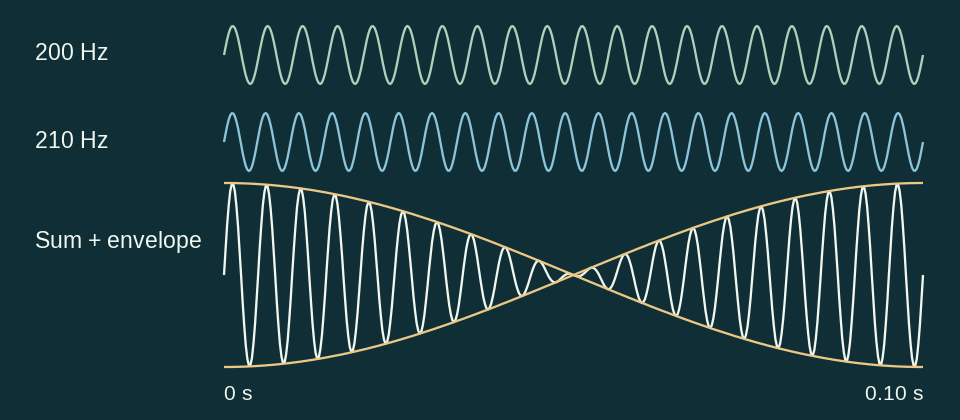
Add 200 Hz and 210 Hz in one channel and the amplitude rises and falls ten times per second. Move the two tones to 350 Hz and 360 Hz and the pitch range changes, while the difference remains ten. With each tone in a different ear, that amplitude envelope is absent from the individual signals. A listener may perceive a 10 Hz binaural beat. [1]
Try the app’s tone arithmetic
Explore the wave relationships
Change the controls to compare signals. This diagram is silent.
The default example uses a 200 Hz carrier and a 10 Hz beat or pulse rate.
Conceptual signals over 0.20 seconds. Move the sliders to compare the relationships. The traces show audio waveforms and envelopes, with no EEG data or playback.
The accepted Restful Tones implementation uses the displayed carrier for the left channel in conventional binaural mode. The right channel uses carrier plus beat. The carrier control is a base frequency, so a displayed 200 Hz with a 10 Hz beat gives 200 and 210 Hz, with a midpoint of 205 Hz. The calculator follows the app’s 80–600 Hz carrier and 0.5–40 Hz beat ranges. It can illustrate the arithmetic even where an individual hears little or no binaural beat.
| Setting | Left ear | Right ear | Difference |
|---|---|---|---|
| Low carrier | 200 Hz | 210 Hz | 10 Hz |
| Higher carrier | 350 Hz | 360 Hz | 10 Hz |
| Smaller offset | 200 Hz | 204 Hz | 4 Hz |
Amplitude, waveforms and harmonics
Amplitude measures how far a signal swings from its mean. It influences loudness, alongside pitch, playback level and hearing sensitivity. A sine wave has a single frequency. Many periodic wave shapes contain harmonics, or integer multiples of their fundamental. A square-like waveform, for example, has a different harmonic balance from a sine wave, even at the same fundamental. In the app the isochronic setting shapes a sine carrier with a smooth repeating amplitude change. Sharp and smooth pulses can sound different, even when their rates agree.
A mixed two-tone signal is a superposition. Its two input pitches need not be harmonics of each other. For equal-amplitude sines, the sum can be written as a faster sine multiplied by a slower cosine. The magnitude of the cosine envelope peaks at the difference rate, so 200 and 210 Hz give ten peaks each second.
Choosing a carrier by ear
Historical manuals explored “carrier-frequency windows” in which a beat was thought to be more noticeable or to have particular effects. Pitch separation, absolute pitch and a listener’s hearing can affect beat perception. That observation is different from an established treatment window or a recommended pitch for an organ. Try a gentle setting in Create a Mix in the Restful Tones app, keeping the beat rate fixed while you change the carrier. Compare how the tones sound at a comfortable level. The Harmonic Box X article shows how this arithmetic extends to four tones. [2]