
The Restful Tones arrangement
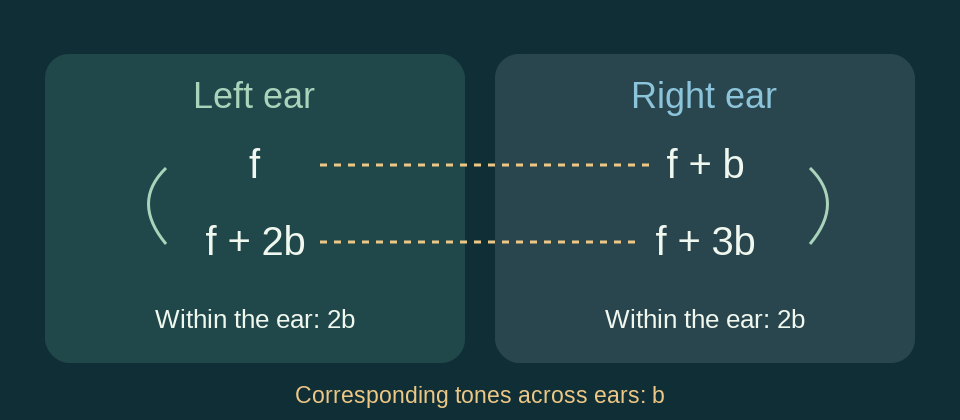
| Channel | First tone | Second tone | Within-channel difference |
|---|---|---|---|
| Left | 200 Hz (f) | 220 Hz (f + 2b) | 20 Hz |
| Right | 210 Hz (f + b) | 230 Hz (f + 3b) | 20 Hz |
The app averages two sine waves in each channel. The within-channel pair differs by 2b, so each channel carries a monaural amplitude envelope at 20 Hz in this example. The corresponding pairs across channels, 200 versus 210 and 220 versus 230, differ by b, or 10 Hz. Other arithmetic differences exist, including a 30 Hz cross-channel difference. This does not mean every numerical difference will be heard as its own distinct beat. Perception depends on the pitches, separation, balance and listener. [1]
Compare the four modes
Explore the wave relationships
Change the controls to compare signals. This diagram is silent.
The default example uses a 200 Hz carrier and a 10 Hz beat or pulse rate.
Conceptual signals over 0.20 seconds. Move the sliders to compare the relationships. The traces show audio waveforms and envelopes, with no EEG data or playback.
The graph plots both channels without summing them during stereo listening. Switch to monaural mode to see one signal shared by the two ears. Switch to binaural mode to see single tones in separate channels. Switch to isochronic to see a tone that is amplitude-modulated directly. The plots use the accepted app’s base pitch and offset conventions.
Why stereo matters
To hear the complete arrangement, use stereo headphones with mono mixing turned off. Through a single speaker, left and right are combined or one channel is lost, depending on the device. In a room, each ear also hears some contribution from both speakers. The combined sound can still contain physical amplitude fluctuations, with different relationships from isolated stereo channels.
Four-tone and Box X designs occur in historical sound-machine literature. Here the label refers to the particular arrangement used in Restful Tones, rather than a standard EEG classification. A more intricate sound does not establish stronger neural synchronization or greater benefit. Compare it with one simpler method at a comfortable low volume and choose by preference. [2] [3]