The patterns we can hear and see
A heartbeat repeats on the scale of seconds. The sleep–wake cycle unfolds over a day. Earth takes a year to circle the Sun. These are recurring patterns, but the repeating processes are different. In acoustics, sound is a mechanical disturbance carried through a medium such as air, water or a solid. Put a light material where that disturbance moves something, and an otherwise invisible vibration can leave a visible trace.
A useful way to explore any example is to ask what moves, what supplies the energy, and what exactly is measured. On a plate the answer may be the plate’s displacement. In a person listening to a beat, it might be a perception, or a signal measured from the scalp. With planets, the numbers usually describe motion through space.
Cymatics: when vibration draws a figure
In his 1787 study of sound, Ernst Chladni described making figures visible on a vibrating plate. Exciting a plate near one of its natural modes makes some areas move strongly while others barely move. Loose grains are shaken away from the high-motion areas and tend to collect along the low-motion lines. The result is a map of the plate’s response. Mount the plate differently, change its geometry or excite a different mode and the map changes. [1]
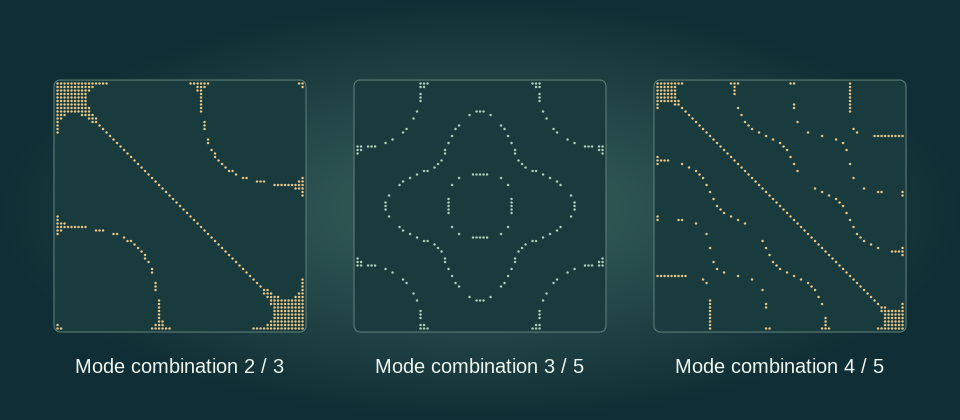
A standing wave can be understood as an interference pattern in which reflected and incoming waves maintain fixed nodes of low motion and antinodes of larger motion. A single dominant mode can give a stable-looking figure. Nearby frequencies or competing modes can produce a pattern that shifts or beats. Grain size, damping and drive amplitude all affect what is visible. Stronger drive can also bring out behavior that a small-amplitude model does not predict.
In the twentieth century Hans Jenny documented patterns in powders and liquids and used the term cymatics for the study. Sand and Lycopodium powder reveal motion differently from water, oils or viscous mixtures. In liquids, surface ripples, traveling waves and sustained circulation can coexist. Oscillatory motion can lead to steady flows, called acoustic streaming, and those flows can form rotating currents. The container’s boundaries, the fluid’s viscosity and the direction of drive matter. Some demonstrations show three-dimensional surfaces or concentrations rather than a flat sand pattern. A geometric shape alone does not establish which mechanism made it.

The experiments show that vibration can organize existing matter under particular conditions. They do not answer the historical or theological question of how matter originally came to exist. [2] [3]
Resonance, harmonics and entrainment
Resonance is an enhanced response to a drive close to a natural mode. Push a swing at the right times and the energy adds up. Two nearby tuning forks of the same pitch can interact through air or a shared support if enough energy transfers. Damping, geometry and the coupling determine the result. Sharing a number in hertz is insufficient on its own.
Harmonics are components at whole-number multiples of a fundamental. A string with a 200 Hz fundamental can also have components at 400 and 600 Hz. The mixture helps give a note its timbre. Some vibrating systems, including many plates, have natural modes whose frequencies are not integer multiples.
Entrainment in dynamical systems means one rhythm adjusts its timing in relation to another or to a periodic drive. Walking to a drum may be deliberate. An electrophysiology experiment uses quite different criteria to determine whether a measured response follows a stimulus. The interaction and the measurement each matter. [4]
From a vibrating plate to a stereo beat
Mix 200 Hz and 210 Hz in one channel. The two waves repeatedly reinforce and oppose one another. The magnitude of the amplitude envelope peaks ten times per second, which is a 10 Hz monaural beat. Present the two tones separately to the ears and a listener may instead hear a binaural beat at the difference. Neither single channel contains the physical monaural envelope. Stereo headphones help keep the channels separate. [5]
Explore the wave relationships
Change the controls to compare signals. This diagram is silent.
The default example uses a 200 Hz carrier and a 10 Hz beat or pulse rate.
Conceptual signals over 0.20 seconds. Move the sliders to compare the relationships. The traces show audio waveforms and envelopes, with no EEG data or playback.
An isochronic tone repeats a pulse at regular intervals by varying a tone’s amplitude. The Restful Tones mixer uses a smooth repeating amplitude change. Harmonic Box X uses two tones in each stereo channel, creating both within-channel and across-channel differences. See the four-tone diagram and calculator.
Cymatics and rhythmic audio share wave interference, frequency relationships and periodic stimulation. A vibration pattern photographed in matter, a beat that a listener reports, and an EEG signal are different observations. An EEG experiment may measure an evoked response tied to the timing of the sound, or ask whether the power of an ongoing rhythm changes. These outcomes need separate interpretation. They cannot be inferred from a sand figure.
Binaural beats and EEG: 14 studies in one review
- Results consistent with the hypothesis
5 of 14 5 - Results inconsistent with the hypothesis
8 of 14 8 - Mixed results
1 of 14 1
| Research | What was measured | What the result supports |
|---|---|---|
| 2019 binaural-beat meta-analysis | Behavioral outcomes across studies | Reported pooled effects in several tasks. It did not establish EEG synchronization. |
| 2023 binaural-beat EEG review | Oscillatory EEG responses across heterogeneous studies | Findings were inconsistent. The review called for better standardized methods. |
| 2013 and 2019 closed-loop sleep studies | EEG and memory after sounds timed to measured sleep waves | Both reported effects on oscillations. Memory findings differed. |
A headset recording is very different from an experiment that senses an individual sleeper’s EEG and schedules each sound in response. These distinctions still leave room for interesting research. [6] [4] [7] [8]
Acoustic manipulation in the laboratory
In acoustofluidics, a device sends controlled mechanical waves through a small volume of liquid. An acoustic radiation force can move suspended material relative to the liquid. Which way it moves depends on the particle, fluid and wave field. Acoustic tweezers use these forces to guide particles or living cells under carefully controlled conditions. Published experiments have positioned single cells and other small objects in a microfluidic channel. [9] [3]
Both experiments and classic cymatics rely on physical waves acting on existing material. A microfluidic device controls the transducer, geometry, field and sample. Its results say nothing about a speaker or headphones reconstructing a tissue or organ.
An orchestra of biological rhythms
The heart beats, the respiratory system moves air, and biological clocks help organize activity and sleep over roughly 24 hours. Sleep itself passes through several stages. Electrical rhythms in the brain coexist and vary by location and activity. In an orchestra, the instruments can coordinate without playing the same note. The body likewise uses interacting rhythms with different jobs and timescales.
Homeostasis is regulation through feedback. The autonomic nervous system adjusts functions including heart rate and blood vessel tone as demands change. Sleep pressure and circadian timing work together to shape when sleep is most likely. Flexible regulation is more informative than a claim that the body has one correct frequency. [10] [11] [12]
Breathing, singing and cardiovascular timing
A person who takes six breaths per minute takes one breath about every ten seconds, or 0.1 Hz. That is the breathing rate, not the heartbeat rate. A heart beating 60 times per minute beats at 1 Hz. The intervals between heartbeats can lengthen and shorten as respiration changes. Heart-rate variability describes changes in those intervals.
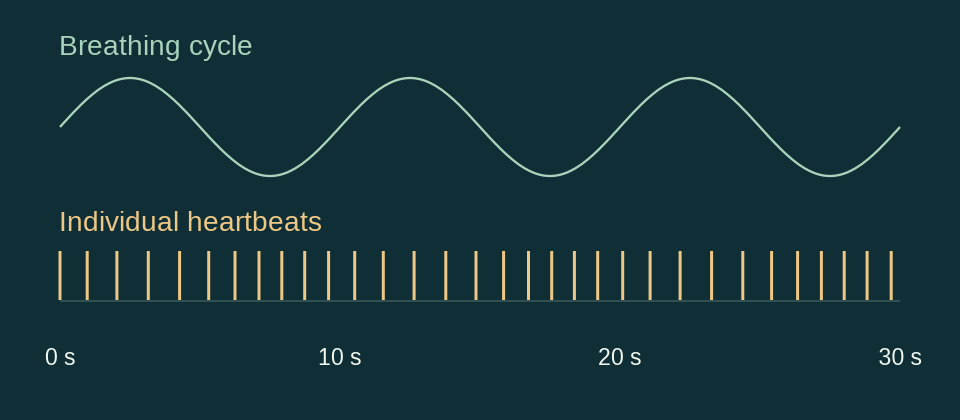
Vickhoff and colleagues observed that different singing structures shaped breathing and the timing of heart-rate fluctuations in singers. In a separate study, Bernardi and colleagues found that rhythmic recitation of the rosary or a yoga mantra slowed breathing to about six cycles per minute and altered measured cardiovascular rhythms. Neither experiment establishes a universal breathing prescription or a medical benefit from listening to a track. The physiological measurements address timing. They do not assess the meaning of prayer to participants. [13] [14]
Peter Guy Manners and historical cymatic therapy
Peter Guy Manners appears in the historical documentary below. He proposed that tissues or organs had characteristic vibrational relationships and that externally applied vibration could restore a disturbed relationship. This is a historical theory. The visual demonstrations show physical patterns, and a clinical claim requires separate evidence about a defined intervention and patient outcomes.
One historical analogy compared transplant rejection to mismatched harmonics. Conventional transplant immunology explains rejection through the recipient’s immune response to the graft. Compatibility tests and immune-directed care address that process. Similarity in an acoustic pattern cannot establish transplant compatibility. [15]
Historical Cymatics Documentary Series — Four Parts
These historical recordings mix physical demonstrations and interviews with medical theories. The plates and liquids are worth looking at on their own. The therapy proposals in the documentary lack the clinical support needed to treat them as medical guidance.
Cymatics full documentary (part 1 of 4). Bringing matter to life with sound
Cymatics Full Documentary (Part 2 Of 4). The Healing Nature Of Sound
Cymatics full documentary (part 3 of 4). Application of Cymatic Therapy
Cymatics full documentary (part 4 of 4). Experiments In Animation With Sound & Vibration
Royal Raymond Rife — A Controversial Chapter in Frequency Research
Royal Raymond Rife (1888–1971) was an American inventor who developed optical instruments for observing microorganisms. In December 1931 he and Northwestern University bacteriologist Arthur Isaac Kendall published a preliminary report, Observations on Bacillus Typhosus in Its Filterable State, in California and Western Medicine. It described laboratory observations, distinct from a clinical study. Rife’s microscopes also attracted contemporary press attention. [34] [35]
Rife proposed that disease-causing microorganisms responded to particular electromagnetic frequencies. He believed that a sufficiently strong response at what he called a Mortal Oscillatory Rate could disable or destroy a microorganism. The idea resembles acoustic resonance in the limited sense that a system can respond more strongly to some frequencies than others. His experimental devices used electromagnetic energy, whereas ordinary audible sound consists of mechanical waves. Reliable clinical evidence that Rife machines effectively treat cancer or other diseases is lacking. [16]
For a closer look at the optics, the Science Museum Group collection record includes photographs of Rife’s surviving 1938 microscope. [36]
The mysterious laboratory fire of 1939
On March 12, 1939, a fire destroyed the laboratory of Dr. John C. Burnett in Alpine, New Jersey. Burnett was associated with Rife and investigated electronic approaches to disease. Newspaper accounts published the following day reported losses of scientific apparatus, including equipment associated with Burnett’s cancer research. The building belonged to the Burnetts. Rife’s San Diego laboratory was a different site. [35] [37]
A contemporary Associated Press report mentioned a suspected electrical short. That was a preliminary account of the cause. The surviving reporting establishes the fire and the loss of the laboratory, while providing no reliable basis to attribute it to arson, pharmaceutical interests, the American Medical Association or the Rockefeller family. The newspaper collection is maintained by supporters of Rife’s research. Its reproductions of contemporary reporting are distinct from the archive’s own commentary. [35]
Professional opposition and the alleged suppression of Rife’s discoveries
The company that took the name Beam Rays Inc. in 1938 manufactured experimental plasma devices. In 1939 it became involved in disputes over ownership, receivership and marketing rights. The supporter-maintained Rife Historical Documents collection lists agreements, complaints, affidavits and proceedings. Some documents are only catalogued, and the posted trial transcript is unofficial and incomplete. These records document commercial disputes. Statements made by a party in a filing still need corroboration. [38] [35]
Later accounts allege that figures in organized medicine tried to acquire or suppress the technology. Some name Morris Fishbein, a prominent figure in the American Medical Association. A separate story describes sixteen cancer patients reportedly treated successfully in 1934. The available historical material leaves the alleged campaign and individual motives unresolved. Independently verifiable clinical records sufficient to confirm the reported cures are lacking. A lawsuit over a device establishes that a dispute occurred. Its clinical effectiveness would require evidence about patients and outcomes. [38] [16]
Rockefeller and the transformation of modern medicine
In 1910 Abraham Flexner published a Carnegie Foundation report examining 155 medical schools in the United States and Canada. It advocated stronger training in the sciences, better laboratory facilities and closer links between medical schools and clinical practice. John D. Rockefeller’s General Education Board later directed substantial resources to medical education reforms. [39] [40]
Higher standards and investment improved training at many institutions. The resources needed to meet those standards were unevenly distributed. Smaller schools and schools that taught alternative traditions faced pressure. Leila Morsy documents how the reforms and unequal funding disadvantaged Black medical schools and narrowed opportunities for Black physicians. This history warrants scrutiny of how funding shapes research and professional practice. The records of these reforms provide no direct evidence of a Rockefeller campaign against Rife. [40] [41]
Did Rockefeller change music from 432 Hz to 440 Hz?
Musicians used many reference pitches before standardization, and practices varied among regions, ensembles and instrument makers. France adopted A = 435 Hz in 1859. A = 432 Hz was among later proposals, including in Italy. In 1939 an international conference agreed on A = 440 Hz as a reference. Historian Fanny Gribenski traces the outcome to decades of negotiations involving musicians, physicists, broadcasters and instrument makers. That history supplies no convincing evidence that Rockefeller directed the change to suppress healing or influence consciousness. [42] [43]
A 2019 double-blind crossover pilot study had 33 volunteers listen to the same music at both tunings on separate occasions. The authors reported a modestly lower average heart rate in the 432 Hz condition, along with some differences in listeners’ ratings. They called for larger studies. The journal also published a correction. A small, short-term study cannot establish lasting health effects, universal benefits from 432 Hz, or harm from 440 Hz. Listeners can prefer one tuning on its own musical merits. [44] [45]
Is modern science revisiting some of these fundamental questions?
Modern research tests how specific forms of acoustic, electrical and magnetic energy interact with living tissue. Each example uses a distinct mechanism.
- Focused ultrasound concentrates acoustic energy at a chosen target. Some systems use the focus to heat tissue. [46]
- Histotripsy uses controlled ultrasound pulses and the motion of bubbles to mechanically disrupt targeted tissue. [18]
- Tumor Treating Fields use alternating electric fields to interfere with cell division in certain cancer treatment settings. Research continues into the exact mechanisms. [47]
- Radiofrequency ablation delivers energy through electrodes to heat a targeted area. [48]
- Transcranial magnetic stimulation uses a changing magnetic field to induce currents that influence brain activity. [49]
- Acoustic tweezers use sound-generated forces to manipulate small particles or living cells in laboratory settings. [9]
Frequency is one variable among several. Intensity, delivery, the biological target and evidence from controlled studies all matter. The findings apply to the devices and uses studied. They establish neither the effectiveness of Rife machines nor comparable medical effects from listening to music or brainwave entrainment tracks.
Open inquiry and scientific responsibility
Unconventional ideas can encounter skepticism and institutional obstacles. Historical research can examine those obstacles and the incentives behind them. Claims about treatment require a different kind of inquiry, including reproducible methods, measurable outcomes and independent evaluation. Keeping those questions separate makes it possible to take both the history and the science seriously.
Restful Tones offers recordings and customizable sound environments for personal listening. Rife treatments and medical devices fall outside that purpose.
Where sound is used in medicine
Diagnostic ultrasound sends high-frequency mechanical waves into the body and uses echoes to construct an image. Focused ultrasound concentrates acoustic energy at a target. Some systems are designed to heat tissue in a controlled way. Histotripsy uses focused pulses to form a bubble cloud and mechanically disrupt target tissue. These are applications with engineered exposures, imaging or targeting, and defined clinical indications. [17] [18]
Mechanotransduction is how cells turn a physical stimulus into a biological signal. Mechanically sensitive ion channels, including PIEZO channels, help explain how touch or stretch can change cell signaling. This makes the study of physical forces in biology compelling. It supplies no basis for assigning an organ a single healing pitch. [19]
Rhythmic auditory cues are also used in some rehabilitation settings to help time movements such as steps. Music-based interventions can involve trained practitioners and specific outcomes. Their evidence depends on the intervention and the condition being studied. Ordinary personal listening is a separate activity. [20] [9]
Natural geometry and molecular vibrations
Snow crystals grow with a sixfold symmetry related to the underlying ice lattice. Branches and veins can form networks as tissues grow and transport resources. Many plants show spiral arrangements shaped by growth and packing. Musical intervals can express simple ratios, such as the 2:1 frequency ratio of an octave. A similar-looking geometry can arise through different processes.
Molecules also have characteristic motions. Infrared spectroscopy observes absorption associated with changes in electric dipole during vibration. Raman spectroscopy measures small shifts in scattered light associated with molecular motions, typically requiring a change in polarizability. These are measurements in the energy range of molecular vibrations. They do not turn a musical pitch into a tool for altering DNA. [21] [22]
Geometries such as the Flower of Life can be appreciated as cultural and artistic patterns. A resemblance to a plate figure, a crop circle or a crystal cannot establish the cause of the pattern or a universal mechanism of life.
The music of the spheres
The Pythagorean tradition connected simple musical intervals with numerical ratios. Johannes Kepler returned to cosmic harmony in Harmonices Mundi (1619), comparing planetary motions with musical relationships. Modern orbital resonance has a specific meaning. When the periods of orbiting bodies are close to a simple ratio, repeated gravitational interactions may reinforce a pattern. The familiar near 1:2:4 period relationship among Io, Europa and Ganymede is an example. No sound needs to travel between the moons. [23] [24]
| Planet | Rotation (hours) | Rotation (Hz) | Orbit (days) | Orbit (Hz) |
|---|---|---|---|---|
| Mercury | 1407.6 | 1.973e-7 | 88 | 1.315e-7 |
| Venus (retrograde) | 5832.5 | 4.763e-8 | 224.7 | 5.151e-8 |
| Earth | 23.93447 | 1.161e-5 | 365.25636 | 3.169e-8 |
| Mars | 24.6 | 1.129e-5 | 687 | 1.685e-8 |
| Jupiter | 9.9 | 2.806e-5 | 4331 | 2.672e-9 |
Periods are measured relative to the stars where applicable. Frequencies are positive magnitudes calculated as one divided by the period in seconds. Venus rotates in the opposite direction to Earth. [25] [26]
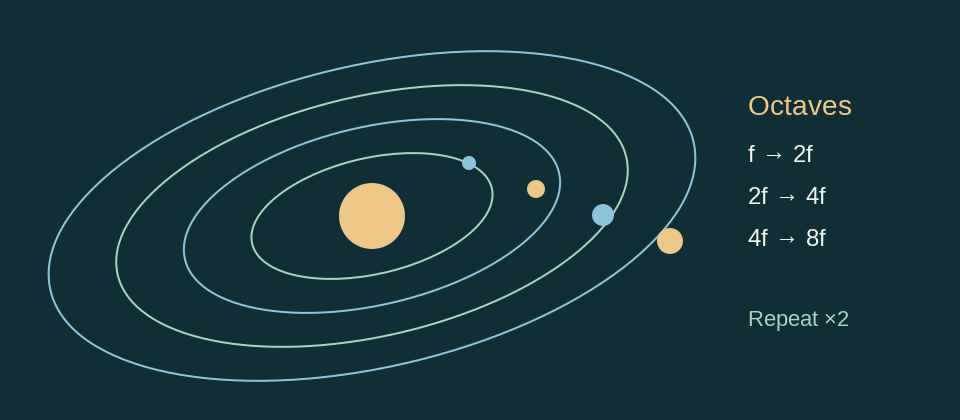
Earth’s sidereal year corresponds to about 3.17 × 10⁻⁸ Hz. Multiply that by 232 and the result is about 136.1 Hz. The arithmetic brings an extremely slow period into the musical register. It does not capture a sound naturally radiated by the Earth’s orbit.
NASA sonification projects turn data into sound by assigning values such as brightness or position to musical features. Other projects translate measured solar oscillations, pressure waves or plasma waves into audible ranges. Back in a medium such as a star or a gas cloud, a pressure wave can really propagate. The sound presented to listeners may still involve rescaling or conversion. A musical mapping has no established healing effect. [27]
The Schumann resonance
Earth’s surface and the ionosphere form a cavity for extremely low-frequency electromagnetic waves. Lightning supplies much of the excitation. Instruments commonly detect a broad lowest mode near 7.83 Hz and higher modes near 14, 20 and 26 Hz. Real values shift with conditions. These are cavity modes with their own spacing, rather than 7.83 multiplied by consecutive integers. [28]
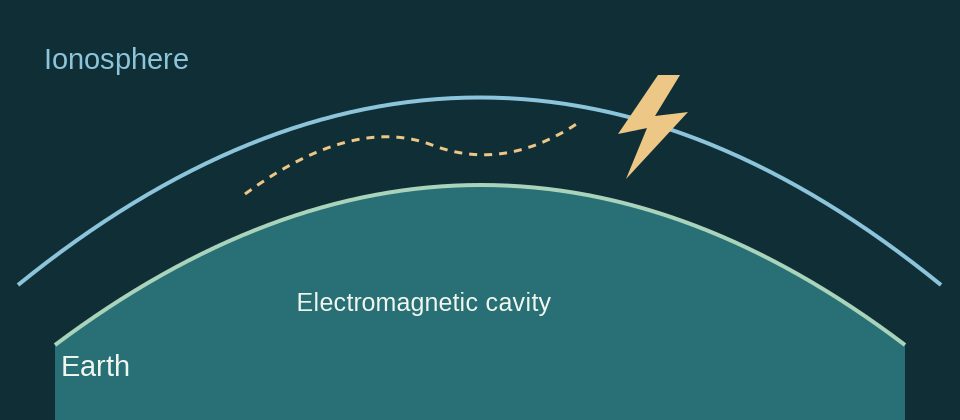
The number 7.83 happens to be near a commonly drawn theta–alpha boundary. An electromagnetic field oscillation, the rate of audio modulation and an electrical rhythm generated by neurons are distinct phenomena. Possible biological coupling is a research question that requires exposure measurements and controlled experiments. A track with a 7.83 Hz modulation is an audio design choice. [29]
Why natural soundscapes can feel restorative

Water trickles, waves return with some variation, and birdsong comes and goes. A recording can make a room feel less acoustically empty and its background less abrupt. A review by Buxton and colleagues found evidence of perceived benefits and changes in measures such as stress and annoyance across studies of natural sounds. Sounds, settings and outcome measures differed. The same sound can feel pleasant in one setting and intrusive in another. [30]
Try choosing the sound that fits the setting. Rain may feel familiar at bedtime. Wind or birdsong may be welcome in the afternoon. An ambient soundscape is a companion for personal listening, and quiet is an equally valid choice.
The Divine Harmony — Sound, Music and the Christian Mystical Tradition

Long before modern acoustics, neuroscience and cymatics, Christian mystics, theologians and philosophers considered what music might reveal about creation and the inward life. Some heard in it an expression of divine order. Others turned to the language of resonance, tension and harmony to describe prayer, the awakening of understanding or humanity’s relationship with God. Their writings offer historical and theological perspectives alongside physical studies of vibration and form.
The creative Word of God
Genesis repeatedly presents creation as a response to God’s speech. Hebrews 11:3 also speaks of the worlds being framed by God’s word. John’s Gospel gives this language its distinctly Christian meaning by identifying the divine Word with Jesus Christ. Biblical quotations here use the public-domain 1901 American Standard Version. The King James Version is included for comparison in the sources. [50] [31]
And God said, Let there be light: and there was light.
In the beginning was the Word, and the Word was with God, and the Word was God.
John adds that “All things were made through him” (John 1:3). Psalm 33:6 brings the word of God and the breath of his mouth together in its account of the heavens. In Job 38:7, “the morning stars sang together,” a poetic image of creation rejoicing. Scripture’s language of speech, breath and song points to God’s creative activity. The divine Logos is personal and divine, revealed in Jesus Christ. Sound, light, matter and motion belong to the order he creates and sustains. [50]
Clement of Alexandria — Christ as the New Song
Clement of Alexandria (c. 150–215) opens his Exhortation to the Heathen, also known as the Exhortation to the Greeks, with a contrast between the songs of Greek tradition and Christ as the New Song. In his imagery the Word tunes the universe through the Holy Spirit. The human person, body and soul together, is a small world and an instrument capable of answering that music. [51]
A beautiful breathing instrument of music the Lord made man, after His own image.
Clement draws on the account of David playing for Saul. His concern goes beyond the effect of an instrument on a listener. The discordance of human life is met by Christ, who restores people to relationship with God. Harmony here is a way of speaking about redemption, participation and the work of the Holy Spirit.
Hildegard of Bingen — the symphonic soul
Hildegard of Bingen (1098–1179) was a Benedictine abbess, visionary and composer. In a letter to Bernard of Clairvaux dated 1146–1147, she connects the Word through whom the world came to be with a holy sound echoed throughout creation. The letter is an appeal for spiritual discernment, expressed through the imagery of creation and the Incarnation. [52]
In 1178–1179 she wrote to the prelates of Mainz after her community’s liturgical singing was restricted. Her appeal recalled the beauty she associated with the human voice before the Fall. Singing in worship, in her account, remembers a harmony obscured by separation from God and gives voice to heavenly praise. She describes the soul in symphonic terms. Her chants collected as Symphonia armonie celestium revelationum let readers and listeners encounter that vision in song. [53] [54] [55]
Music can carry emotion, memory, longing and gratitude when ordinary speech feels inadequate. For Hildegard the highest purpose of sacred song was the praise of God. This is a theology of creation and worship with no claim about a particular healing frequency.
Jakob Böhme — sound and inward nature
Jakob Böhme (1575–1624), a German Christian mystic, compares the outward form of a thing to a lute lying silent. When it is played, its tuning and character become audible. For Böhme this is an analogy for how outward expression can disclose something hidden. He makes a similar point about teaching. A person may hear religious words without grasping them inwardly. Understanding depends on a response in the hearer, pictured by “the Hammer that can strike my Bell.” [56]
The image recalls sympathetic resonance. One instrument can stir a response in another under suitable physical conditions. In Böhme’s analogy the responding person comes to understand something that the sounds of words alone cannot convey. In his wider metaphysics, sound belongs to the expression of inward qualities. His seven qualities of eternal nature involve such ideas as desire, motion, tension, fire, light, sound and outward manifestation. Translations differ in their terms.
Cymatics makes otherwise hidden mechanical motion visible through its effects on material. Böhme asks how inward qualities become known through expression. The parallel is in the act of revealing something hidden. His metaphysical account stands on its own terms, independent of what a vibrating plate can establish.
Augustine and Boethius — the three forms of music
Augustine of Hippo (354–430) explores rhythm, number and proportion in De musica. Measured relations in music can invite reflection beyond the moment of hearing. For Augustine those relations open a philosophical and theological question about order and its source. Boethius (c. 480–524), in De institutione musica, distinguished three senses of music that shaped medieval thinking. [57]
- Musica mundana — the music of the universe
- The proportions and order he associated with the heavens, elements and seasons.
- Musica humana — the music of humanity
- The harmony he understood to hold among aspects of a person, including body and soul.
- Musica instrumentalis — audible music
- Music made perceptible through the voice or an instrument.
Orbital resonances, biological clocks, brain rhythms and molecular oscillations have their own modern descriptions and measurements. They offer fresh reasons to appreciate the old symbolism while leaving its cosmology a historical account. As with an orchestra, coordination can involve many distinct rhythms. The body has no single universal frequency of perfect health.
John of the Cross — silent music
In the Spiritual Canticle, the Spanish Carmelite John of the Cross (1542–1591) sees the Beloved through images of mountains, valleys, waters and winds. He also speaks of a harmony available in stillness. [58]
The silent music,
The murmuring solitude.
John’s commentary describes creation’s diversity as bearing many kinds of witness to God. Their unity is heard in contemplation through the wisdom and love of the Beloved. This inward music requires no audible instrument. A gentle sound may accompany reflection, and stillness can be meaningful on its own.
Eastern Christianity — prayer, rhythm and stillness
Hesychasm, named for the Greek word associated with stillness, is an Eastern Orthodox tradition of watchfulness and continual prayer. It is especially associated with the Jesus Prayer:
Lord Jesus Christ, Son of God, have mercy on me, a sinner.
Some historical versions of the practice coordinate prayer with breathing or inward attention. Gregory Palamas (1296–1359) defended the tradition in the fourteenth century. The aim is communion with God. Breath, posture, rhythm and silence may accompany prayer. Divine grace is received, beyond what any breathing or listening technique can produce. [59]
A 2001 BMJ study measured breathing and cardiovascular rhythms during recitation of the rosary and a yoga mantra. The researchers observed that both practices slowed breathing and affected measured coordination. Their study concerned those vocal practices and physiological measures. It did not test Hesychasm, measure spiritual experiences or establish a method for obtaining them. [60]
Christian-influenced esotericism — formative sound and cosmic harmony
Hermetic, Rosicrucian and Anthroposophical writers took the symbolism of sound in more speculative directions. Their ideas belong to distinct historical movements and differ in important respects from conventional Christian doctrine.
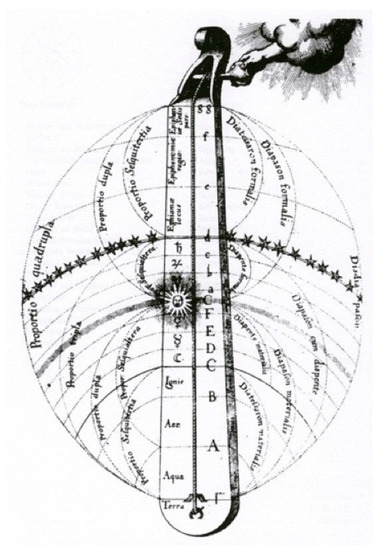
Robert Fludd — the Divine Monochord
Robert Fludd (1574–1637), an English physician and Hermetic writer, pictured creation as a single-string instrument tuned by a hand emerging from a cloud. The intervals connect elemental and celestial spheres. Fludd’s microcosm and macrocosm imagery sees humanity as a small world echoing the greater one. The engraving records a symbolic cosmology, with no role as a physical map of the heavens. [61]
Max Heindel — formative sound
Max Heindel (1865–1919), founder of the Rosicrucian Fellowship, describes sand forming geometric figures when a plate is set vibrating with a violin bow in The Rosicrucian Cosmo-Conception (1909). He uses the demonstration as an analogy for a metaphysical theory in which archetypal tones shape visible forms. He also interprets the sounds of nature through an imagined harmony of the Earth. His account predates Hans Jenny’s cymatics work. The vibration of the plate explains the observed pattern. The theory of spiritual archetypes belongs to Heindel’s own system. [63]
Rudolf Steiner — sound and the creative Word
Surviving lecture notes dated September 11, 1906 record Rudolf Steiner (1861–1925) discussing speech vibrations and imagining ways their effects might become visible. He extends that observation into a speculative account of the creative Word and the natural world. His wider Anthroposophical discussions of music assign spiritual significance to tones and intervals. Cymatics demonstrates effects on existing matter. It cannot establish the cosmology Steiner inferred. [64]
Scripture, music and the responsibility of speech
In 1 Samuel 16:23 David plays for Saul, who is refreshed. In 2 Kings 3:15 Elisha calls for a musician, and “when the minstrel played, that the hand of Jehovah came upon him” is how the account describes what followed. Acts 16:25–26 portrays Paul and Silas singing in prison before an earthquake. Joshua 6 recounts trumpets, a collective shout and the fall of Jericho in a story about God’s command and Israel’s obedience. These narratives attribute divine action to God. They offer no acoustic formula for reproducing a miracle. [50]
Ephesians 5:19 places “psalms and hymns and spiritual songs” in the ordinary life of worship, including melody made in the heart. Proverbs 18:21 says, “Death and life are in the power of the tongue.” A word can encourage, comfort or reconcile. It can also wound or divide. The sound of a gentle voice carries reassurance through intention and context as well as its tone. The responsibility of speech comes from what our words mean and do to one another. [50]
Ancient insights and modern discoveries
Cymatics shows how mechanical motion can organize existing material. Acoustic research measures how sound moves particles, fluids and some biological material under controlled conditions. Neuroscience observes rhythmic electrical activity. Physiology measures relationships among breathing, circulation and other processes. Orbital astronomy measures recurring patterns of motion, and music research asks how listening relates to memory, attention, emotion and the body. These discoveries give us more to appreciate about natural order. They leave metaphysical claims and questions about divine purpose to their own kinds of inquiry.
Physical harmony and spiritual harmony
A person can be physically relaxed and still lack inward peace. Someone in pain can know deep peace. A beautiful sound or an unusual state of attention cannot tell us whether someone is reconciled to God. Philippians 4:7 speaks of peace in Christ:
And the peace of God, which passeth all understanding, shall guard your hearts and your thoughts in Christ Jesus.
Quiet music, rest and a comfortable place can accompany prayer and reflection. Christian regeneration and communion depend on the life and grace of God. Recordings, meditation settings and tone generators cannot produce them. In that sense the deepest harmony concerns the whole person in right relationship with the One through whom all things exist.
The harmony of creation
From patterns on a vibrating plate to the mathematics of celestial motion, creation gives us much to explore. Clement’s New Song, Hildegard’s symphonic soul, Böhme’s responding instrument, Boethius’s kinds of harmony and John’s silent music each give a different language to wonder. The esoteric writers add more speculative accounts that call for historical discernment. For the Christian, the unity underlying creation is expressed in Paul’s words about Christ:
and he is before all things, and in him all things consist.
Sound can make something of creation’s beauty and order perceptible. The Creator is greater than the physical principles through which creation operates. The wonder of sound ultimately points beyond sound itself.
Musical tuning and popular frequency claims
In a tuning system, a reference such as A4 = 440 Hz sets where the other notes begin. A4 = 432 Hz sets that reference a little lower. With the same intervals, the composition is recognizably the same, shifted in pitch. Listening comparisons can also be affected by tempo, performance, recording and expectations. Preference for either tuning is a reasonable personal choice. [32]
Modern “Solfeggio frequencies” are often presented alongside much older solmization traditions. A historical association or numerical pattern does not establish a health effect. Claims that 528 Hz repairs DNA, or that a tuning detoxifies, heals an organ or induces spiritual transformation, lack reliable evidence as outcomes of ordinary listening.
A reference tuning sets the musical pitch system, a carrier sets an audible tone and a beat rate describes the pace of a difference or pulse. The interactive guide below keeps those ideas separate. Explore carrier pitch and beat rate.
Sound, rest and responsible interpretation
Physical healing concerns tissue and disease. Symptom relief is a change in what a person experiences. Emotional comfort can be meaningful even when no medical condition has changed. Personal well-being includes ordinary things such as enjoying quiet time. In a Christian understanding, spiritual restoration has a different source and purpose again.
Let listening be gentle and optional. Set a comfortable low volume and begin with a short session. Stop if you feel discomfort, a headache or distress. Give driving, machinery and other safety-critical tasks your full attention. If a physical or emotional concern needs care, seek appropriate professional support. [33] [20]
Exploring a sound environment in Restful Tones
The Android app’s built-in mixer lets you select binaural beats, monaural beats, isochronic tones or Harmonic Box X, then adjust carrier pitch and beat frequency. White, pink and brown noise give you different background textures. Individual layer levels, timers and fades let you keep the mix soft. Save a personal mix if you want to return to it. Premium adds ambient music, nature recordings and the rest of the 415-recording library across 15 collections. A single track, a simple mix or silence can each suit a different moment.
Listening to the differences
A plate mode, the curve of a breath and the orbit of a planet each have a rhythm we can describe. The interest comes from understanding how each one works. The same care makes listening richer: notice the small changes in a sound, keep room for your own experience, and let an unanswered question remain an invitation to learn.
Sources and further reading
- Ernst Chladni. Entdeckungen über die Theorie des Klanges (1787).
- Hans Jenny. Cymatics: A Study of Wave Phenomena and Vibration, volumes 1 and 2 (1967, 1972). Historical primary record.
- Xiaoyun Ding and colleagues. On-chip manipulation of single microparticles, cells, and organisms using surface acoustic waves. PNAS (2012).
- Ruth M. Ingendoh, Ella S. Posny and Angela Heine. Binaural beats to entrain the brain? PLOS ONE (2023).
- Gerald Oster. Auditory Beats in the Brain. Scientific American (1973).
- Miguel García-Argibay, Miguel A. Santed and José M. Reales. Efficacy of binaural auditory beats in cognition, anxiety, and pain perception: a meta-analysis (2019).
- Hong-Viet V. Ngo, Thomas Martinetz, Jan Born and Matthias Mölle. Auditory closed-loop stimulation of the sleep slow oscillation enhances memory. Neuron (2013).
- Simon Henin and colleagues. Closed-loop acoustic stimulation enhances sleep oscillations but not memory performance. eNeuro (2019).
- Adem Ozcelik and colleagues. Acoustic tweezers for the life sciences. Nature Methods (2018).
- NHLBI. How Sleep Works: Sleep Phases and Stages.
- NINDS. Brain Basics: Understanding Sleep.
- Nick Kane and colleagues. Revised clinical electroencephalography glossary, IFCN (2017).
- Björn Vickhoff and colleagues. Music structure determines heart rate variability of singers. Frontiers in Psychology (2013).
- Luciano Bernardi and colleagues. Effect of rosary prayer and yoga mantras on autonomic cardiovascular rhythms. BMJ (2001), 10.1136/bmj.323.7327.1446.
- NIDDK. Kidney Transplant.
- Cancer Research UK. Rife machines.
- FDA. Ultrasound Imaging.
- FDA. De Novo decision DEN220087, Edison System (2023).
- Nobel Assembly. The discovery of receptors for temperature and touch (2021).
- NIH NCCIH. Music and Health: What You Need To Know.
- NIST Chemistry WebBook. Infrared spectrum of water in the gas phase.
- C. V. Raman and K. S. Krishnan. A new type of secondary radiation. Nature (1928).
- Johannes Kepler. Harmonices mundi libri V (1619), Smithsonian Libraries collection.
- NASA Astrobiology. Europa: Chewy or Crunchy? The 1:2:4 Laplace resonance.
- NASA NSSDC. Planetary Fact Sheet, metric periods.
- NASA JPL. Astrodynamic Parameters.
- NASA. Data Sonifications.
- W. O. Schumann and later measurement studies, discussed in the Journal of Research of the National Bureau of Standards (1965).
- Global Brain Consortium, Workgroup 6. Comparison of EEG frequency-band conventions.
- Rachel T. Buxton and colleagues. A synthesis of health benefits of natural sounds and their distribution in national parks. PNAS (2021), 10.1073/pnas.2013097118.
- King James Version. Scripture references for the Christian reflection. University of Pennsylvania Online Books Page.
- ISO 16:1975. Acoustics — Standard tuning frequency.
- World Health Organization. Deafness and hearing loss: Safe listening.
- Arthur Isaac Kendall and Royal Raymond Rife. Observations on Bacillus Typhosus in Its Filterable State: A Preliminary Communication. California and Western Medicine (1931).
- Rife Historical Documents. Newspaper Articles. Supporter-maintained collection of contemporary coverage, including the Burnett fire.
- Science Museum Group. Collection record and photographs of Rife’s prismatic compound microscope No. 5 (1938).
- Palisades Interstate Park. Stranger Than Weird. Local history of the Burnett estate and laboratory fire.
- Rife Historical Documents. Court Cases. Supporter-maintained collection of Beam Rays records and an incomplete trial transcript.
- Abraham Flexner. Medical Education in the United States and Canada. Carnegie Foundation Bulletin No. 4 (1910).
- Teresa Iacobelli. Early 20th Century Reforms of Medical Education Worldwide. Rockefeller Archive Center (2022).
- Leila Morsy. Carnegie and Rockefeller’s Philanthropic Legacy: Exclusion of African Americans From Medicine. Academic Medicine (2023).
- Fanny Gribenski. Tuning the World: The Rise of 440 Hertz in Music, Science, and Politics, 1859–1955. University of Chicago Press (2023).
- Fanny Gribenski. Plenty of Pitches. Nature Physics (2020).
- Diletta Calamassi and Gian Paolo Pomponi. Music Tuned to 440 Hz Versus 432 Hz and the Health Effects: A Double-blind Cross-over Pilot Study. Explore (2019).
- Diletta Calamassi and Gian Paolo Pomponi. Published correction to the tuning pilot study. Explore (2020).
- FDA. ExAblate Neuro focused ultrasound. Summary of Safety and Effectiveness Data.
- Francesca A. Carrieri and colleagues. Tumor Treating Fields: At the Crossroads Between Physics and Biology for Cancer Treatment. Frontiers in Oncology (2020).
- National Cancer Institute. Radiofrequency ablation.
- National Institute of Mental Health. Brain Stimulation Therapies, including transcranial magnetic stimulation.
- The Holy Bible, American Standard Version (1901). Public-domain text from eBible.org.
- Clement of Alexandria. Exhortation to the Heathen, chapter I. William Wilson translation, Ante-Nicene Fathers.
- Hildegard of Bingen. Letter to Bernard of Clairvaux (1146–1147). Columbia University, Epistolae.
- Hildegard of Bingen. Letter to the Prelates of Mainz (1178–1179). Latin and English texts compiled by Luke Dysinger.
- Stanford University. Hildegard of Bingen on Music. Introduction to the Mainz letter.
- International Society of Hildegard von Bingen Studies. The Symphonia, musical theology and resources.
- Jakob Böhme. The Signature of All Things, chapter I. Historical English text.
- Stanford Encyclopedia of Philosophy. History of Western Philosophy of Music: Antiquity to 1800. Augustine and Boethius.
- John of the Cross. Spiritual Canticle, commentary on silent music and murmuring solitude. David Lewis translation.
- Orthodox Church in America. Saint Gregory Palamas and the Hesychast tradition.
- Luciano Bernardi and colleagues. Effect of rosary prayer and yoga mantras on autonomic cardiovascular rhythms. BMJ (2001), publisher record.
- Robert Fludd. Divine Monochord, Utriusque Cosmi Historia (1617). Digitized page in Source Library.
- Robert Fludd. Monochordum Mundi (1617). Wellcome Collection engraving, marked public domain in figure 1 of Arts 12 (2023), 209.
- Max Heindel. The Rosicrucian Cosmo-Conception (1909), chapter III. Rosicrucian Fellowship online edition.
- Rudolf Steiner. On the Creator’s Word, Landin, September 11, 1906. Notes by Mathilde Scholl, GA 91, Rudolf Steiner Archive.